Why Teams Fail



Why Teams Don’t Take Off, Teams rarely fail because of a lack of expertise. They fail because direction is unclear, accountability is blurred, and alignment is assumed rather than created. Like an aircraft on the runway with conflicting signals from the tower, organizations stall when trust, clarity, and shared visibility are missing. Everyone is ready but no one has true clearance for takeoff. At q_alizer, we believe performance is not a people problem. It is a system design problem. When data creates transparency, conflict becomes constructive, commitment becomes visible, and results become measurable. This insight explores why teams get stuck — and how changing system logic enables real lift-off.

Why Teams Fail – and What System Design Has to Do With It
Teams rarely fail because of a lack of knowledge. They fail because invisible patterns block collaboration while everyone formally agrees on the same objective. What appears to be a people issue is usually a system issue. Patrick Lencioni described this dynamic as five dysfunctions of a team. Read closely, however, it is less a behavioral model and more a structural diagnosis.
Everything begins with trust — not as sympathy, but as psychological safety. When information is filtered to protect individual position, defensive logic replaces shared inquiry. Meetings may look functional, but functionality is not the same as transparency. Without trust, disagreement never becomes productive friction. And without friction, decisions lack depth. The system stabilizes itself around safety rather than truth.
Where trust is weak, conflict becomes uncomfortable. Teams that value harmony over clarity simulate consensus. Discussions remain polite, signals of dissent remain muted. The cost of this artificial harmony is rarely visible immediately, but it compounds over time. Decisions slow down, misalignment grows, and execution fragments. Avoided conflict does not disappear — it resurfaces as inefficiency.
If conflict is suppressed, commitment never fully forms. Decisions are tolerated rather than owned. Alignment becomes declarative instead of operational. In execution, this shows up as parallel action: individuals follow their interpretation of the strategy while assuming shared understanding exists. The organization moves, but not in one direction.
Without genuine commitment, accountability erodes naturally. Performance becomes private instead of collective. Feedback weakens because the mandate to confront deviation is unclear. This is not a question of character; it is a predictable outcome of structural ambiguity. Systems without visible feedback loops drift toward mediocrity, not because people lack ambition, but because signals lack clarity.
At the final stage, status replaces purpose. Teams still talk about goals, but attention shifts toward protecting roles and influence. The system becomes self-referential. Energy that should serve the mission is redirected toward preserving position. When this happens, the organization loses connection to its external objective. It optimizes internally while underperforming externally.
What appears to be five separate dysfunctions is in reality a cascading system logic. Each stage reinforces the next. The solution therefore cannot be motivational. It must be structural.
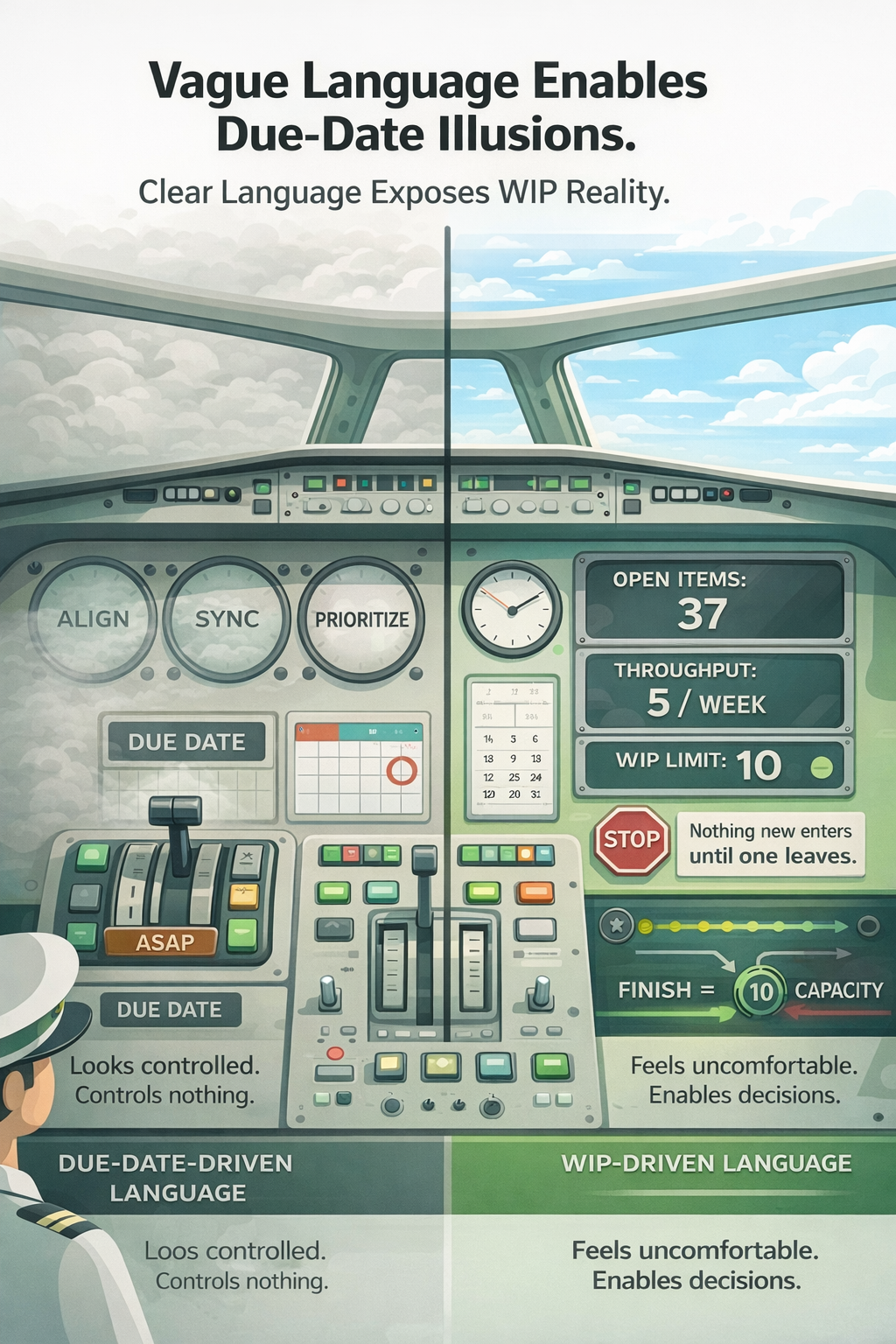
This is where q_alizer intervenes. Not by telling teams to trust each other more, but by changing the visibility architecture in which they operate. When information flows transparently through shared Cockpits and Data Channels, defensive filtering loses power. When conflicting priorities become visible early, friction becomes productive rather than personal. When work-in-progress and due-date dynamics are measurable, commitment is no longer symbolic — it is observable. When deviations trigger feedback automatically, accountability becomes systemic instead of emotional. And when KPIs clearly connect individual action to collective outcome, status loses relevance because results dominate attention.
Teams do not take off because they agree. They take off because they share the same instruments, read the same signals, and trust the same data. Performance is not a cultural coincidence. It is the consequence of system design.
q_alizer does not fix people. It fixes visibility. And when visibility changes, behavior follows.

Get in contact
Intrigued and ready to learn more about how to better fly your plane?
Cool, the team is waiting to give you a demo of how easy your life will be with q_alizer™!
We’d love to talk with you!
Chief Commercial Officer (CCO)
sales@q-alizer.com
+41 76 576 2591
Paul on LinkedIn