When Control Replaces Accountability



Control is often mistaken for safety. In reality, excessive approval loops and due-date–driven decisions erode accountability, slow down operations, and increase risk instead of reducing it. This insight explores why approval-heavy governance models fail, how due-date pressure destroys flow, and why the most effective decisions are made closest to the work. It also shows how WIP-driven steering and clear accountability restore speed, quality, and trust and how q-alizer enables this shift from bureaucratic control to operational confidence.

Why Approval Loops Kill Flow and How WIP-Driven Decisions Restore It
What is often framed as risk mitigation and quality assurance turns out to be its exact opposite.
Across many organizations, unclear responsibilities and ever-expanding approval loops are introduced in the name of safety. In practice, they dissolve accountability. When five signatures are required to move forward, no one owns the outcome anymore — only their individual process step. Decisions degrade into administrative rituals. Responsibility is fragmented. Agility disappears.
This is where operational excellence quietly dies.
Revenue is not generated by compliance. It is generated by speed, clarity, and the ability to make good decisions close to the work. Yet instead of enabling value creation, leadership capacity is consumed by internal approval politics, defensive documentation, and process theater. Documentation stops being a learning instrument and becomes a shield against blame.
Time that should be spent improving processes, serving customers, or preventing quality issues is absorbed by maintaining Excel artifacts whose only purpose is to prove that “the process was followed” — even when the outcome makes little operational or economic sense.
Complexity Is Not a Proxy for Quality
There is an uncomfortable truth most organizations avoid:
Process complexity is often inversely proportional to value creation.
The most effective decision is always made by the person with the highest information density at the point of action — not by the manager farthest removed from the problem. While approval chains grind forward, production waits, deviations age, and risks accumulate unnoticed.
The mistrust embedded in restrictive approval processes is costly. It institutionalizes the assumption that employees cannot be trusted to act in the company’s best interest without constant oversight. This is not quality assurance. It is the formalization of distrust.
Autonomy Needs Boundaries - Not Micromanagement
The mechanism to balance autonomy and control is neither new nor complex. It is clear accountability within defined constraints.
Instead of micromanaging individual steps, leadership sets the boundaries: financial limits, capacity thresholds, and risk tolerances. Within these constraints, decisions are made locally.
A maintenance technician with budget responsibility will allocate resources more effectively than any centralized committee — because uptime, performance, and safety are directly tied to their daily reality. If boundaries are exceeded, corrective action follows. Not preemptively. Not by default.
Empirical evidence from self-organizing systems — from agile teams to organizations like Buurtzorg or Haier’s RenDanHeYi model — confirms this pattern: decentralized decision-making increases speed and engagement while reducing overhead.
Believing that more control creates more safety is not leadership.
It is the administrative management of decline.
The Real Problem: Due-Date–Driven Decisions
Most approval-heavy organizations are not truly risk-driven. They are due-date driven.
Work is prioritized based on deadlines, escalation pressure, or hierarchy — not on system capacity or actual exposure. The consequences are predictable:
- Excessive work in progress
- Constant context switching
- Late decisions with limited impact
- Firefighting disguised as planning
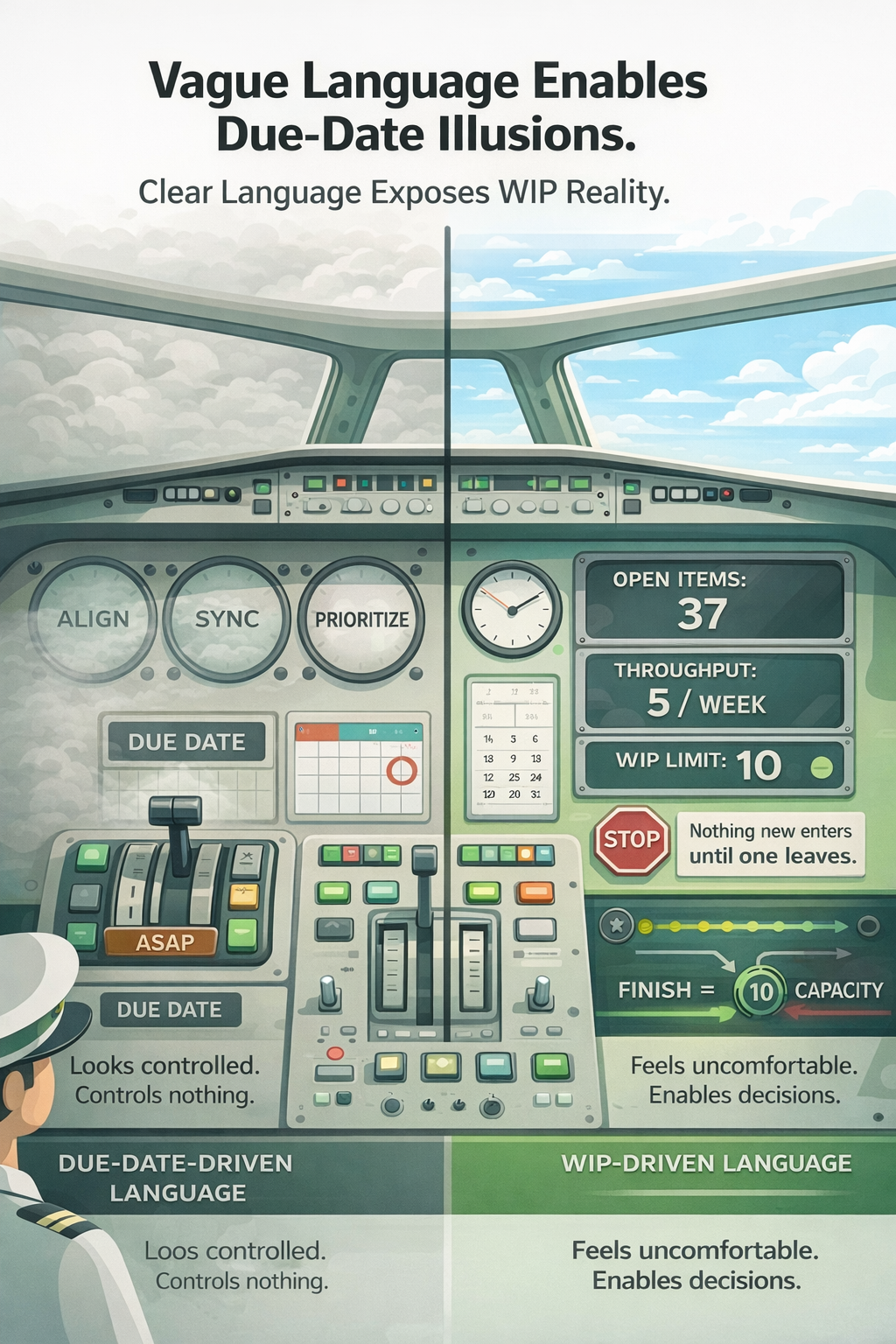
Due-date–driven management creates the illusion of control. Everything is scheduled. Everything has a deadline. Yet nothing flows.
From Due Dates to WIP-Driven Decisions
WIP-driven decision-making focuses on the only variable that truly determines speed, stability, and quality: how much work the system is handling at the same time.
When work in progress exceeds system capacity, quality degrades, lead times explode, and risk increases, regardless of how many approvals are in place.
This is where q_alizer fundamentally changes the game.
How q_alizer Restores Accountability and Flow
q_alizer does not remove governance. It removes blind governance.
Single Source of Truth
q_alizer creates a shared, real-time view of work in progress, risks, bottlenecks, and capacity. Decisions are no longer escalated detached from reality — they are made where data and work intersect.
Explicit Ownership Instead of Approval Chains
Accountability is visible:
- Who owns the decision?
- What outcome is expected?
- By when?
Responsibility is no longer diluted across committees.
WIP-Driven Steering
q_alizer makes queues, overload, and blocked work explicit. Decisions are triggered when WIP limits, risk thresholds, or capacity boundaries are exceeded — not when a due date is about to explode.
Documentation as a By-Product
Evidence is generated from actual actions and outcomes, not from retrospective Excel reporting. Compliance follows operational truth — not the other way around.
Leadership Focused on Flow, Not Policing
Management shifts from approving individual steps to steering the system: stabilizing flow, reducing bottlenecks, and addressing systemic risk early.
The result is faster throughput, earlier risk detection, fewer escalations, and real prioritization.
The Shift That Matters
q_alizer turns due dates from drivers into constraints. Flow becomes the primary control mechanism. Accountability replaces approvals.
q_alizer replaces approval chains and due-date pressure with accountable, WIP-driven decisions, where control comes from flow, not from signatures.

Get in contact
Intrigued and ready to learn more about how to better fly your plane?
Cool, the team is waiting to give you a demo of how easy your life will be with q_alizer™!
We’d love to talk with you!
Chief Commercial Officer (CCO)
sales@q-alizer.com
+41 76 576 2591
Paul on LinkedIn