Buzzwords Are Not a Style Problem.
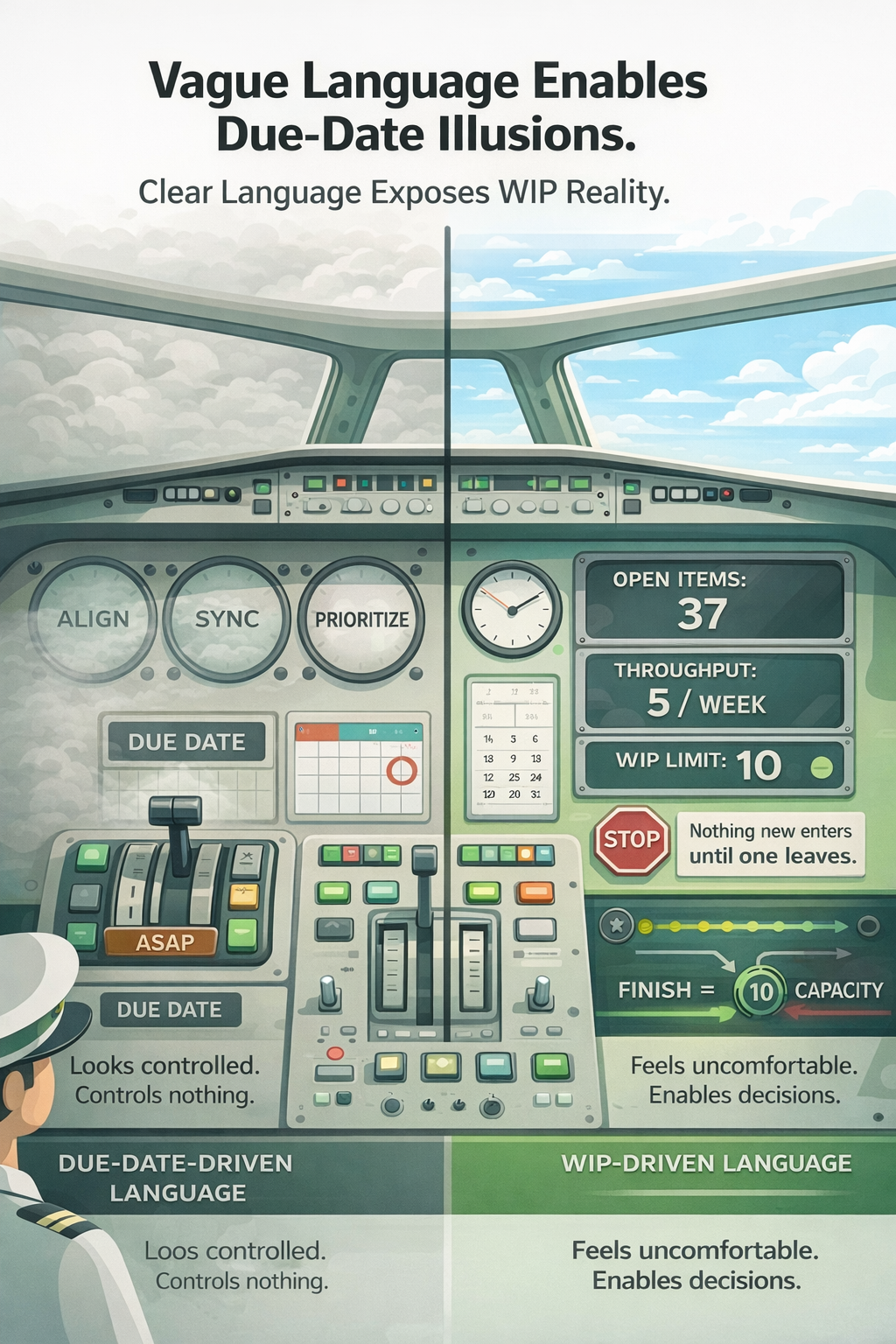


Clarity is not a communication preference. It is a control mechanism. In many organizations, performance problems are discussed as capacity issues, prioritization issues, or alignment issues. Rarely are they recognized for what they often are: decision problems hidden behind vague language. Buzzwords do not fail because they sound bad. They fail because they enable due-date illusions in systems that are overloaded by work in progress. q_alizer Insights focus on the invisible mechanics behind everyday management behavior — how language, decisions, and flow are connected, and why operational excellence cannot be achieved by managing dates, promises, or dashboards alone. This Insight explores why clarity feels uncomfortable, why vagueness feels safe, and how WIP-driven decisions change not only outcomes, but the language organizations use to run their systems.

They Are a Due-Date Illusion.
In many organizations, buzzwords are treated as a communication issue.
As if clearer wording would mainly improve tone or culture.
That diagnosis misses the point.
Buzzwords are not a style problem.
They are a decision-logic problem — and more specifically, a due-date illusion.
The moment language becomes vague, accountability becomes vague.
And when accountability becomes vague, decisions default to dates instead of reality.
Why Due-Date-Driven Systems Love Vague Language
Due-date-driven decisions are built on assumptions:
- assumed capacity
- assumed stability
- assumed throughput
Buzzwords are the linguistic equivalent of those assumptions.
Statements like
“We need to be aligned by end of month” or
“Let’s sync and prioritize ASAP”
sound like action, but they avoid the one thing that matters: current work in progress.
They talk about time — without talking about load.
This is how deadlines stay untouched while reality quietly diverges.
The Cost Is Not Cultural. It Is Operational.
Vague language increases cognitive load.
People must interpret instead of act.
Research on processing fluency shows that jargon-heavy communication:
- reduces understanding
- increases hesitation
- delays decisions
The cost does not show up immediately. It resurfaces later as follow-up meetings, escalations, rework — and eventually as the familiar diagnosis:
“We don’t have enough capacity.”
In most cases, capacity was not the problem. Friction was.
A Familiar Pattern
A delivery is at risk.
So:
- change is announced
- ownership is assigned
- priorities are revisited
The meeting ends with:
“Let’s make sure we’re aligned on the target date.”
Nothing leaves the system.
Nothing stops.
Nothing finishes faster.
The due date remains. The WIP grows.
Why WIP-Driven Decisions Feel Uncomfortable
WIP-driven decisions force clarity:
- What is currently in the system?
- How many items are open?
- Where is work waiting?
- What must stop so something else can finish?
Buzzwords cannot answer these questions.
You cannot “align” a bottleneck.
You cannot “sync” overload.
You cannot “prioritize” without explicitly stopping something else.
So organizations shift the language — away from WIP, toward abstraction.
Not because it works better. But because it feels safer.
The q_alizer Perspective
Flow does not improve by managing dates. It improves by managing work in progress.
And WIP transparency enforces a different kind of language:
- “We have 37 open items; throughput is 5 per week.”
- “This deadline is incompatible with current WIP.”
- “Nothing new enters until something leaves.”
- “To finish this, we must stop that.”
This language feels blunt because it removes interpretation space.
And interpretation space is what keeps due-date illusions alive.
Insight to Action
If decisions are driven by dates, language will remain vague.
If decisions are driven by WIP, language becomes clear — automatically.
Clear language is not the goal. It is the symptom of a system that has switched from promises to flow.

Get in contact
Intrigued and ready to learn more about how to better fly your plane?
Cool, the team is waiting to give you a demo of how easy your life will be with q_alizer™!
We’d love to talk with you!
Chief Commercial Officer (CCO)
sales@q-alizer.com
+41 76 576 2591
Paul on LinkedIn