Why Overtime Culture Isn’t an Efficiency Issue



Overtime is not a sign of commitment but of missing structure. q-alizer shows QC/QA teams worldwide how flow, WIP limits, and data-driven capacity eliminate overload – and why less time often leads to better results.

Why Overtime Culture Isn’t an Efficiency Issue – It’s a Structural One
In many countries, the logic of overtime persists – even where data has disproven it for years. Germany is a particularly visible example. Studies from IAB, Eurofound, and the Federal Institute for Occupational Safety and Health all show the same pattern: Once weekly working time exceeds 40–45 hours, hourly productivity drops significantly. Error rates rise, decisions slow, and rework starts to dominate output.
But this pattern is global. Whether in QC, QA, or production-adjacent teams across the US, Europe, or Asia, the structural illusion that “more time = more results” leads to the same effects everywhere: Fatigue, higher error rates, tunnel vision, and a paradoxical increase in activity without impact.
The problem is never willingness. The problem is the structural misconception that more time automatically creates more output.
Where overtime emerges – and where it destroys value
The scenes look the same worldwide:
- A project team extends their evenings to catch up. Result: more errors, and the following week is already filled with corrections.
- Team leads add “just two more hours” because their target picture is unclear. The extra time merely compensates for lack of planning clarity.
- Employees accumulate overtime because ten priorities run simultaneously. Nothing gets finished, everything remains equally incomplete.
- Leadership teams announce overtime phases during “critical periods.” The true cause – insufficient structure and prioritization – stays untouched.
Eurofound estimates the loss: Up to 20% of value creation is lost through chronic overload.
Psychologically, engagement goes down while exhaustion and decision latency go up. Ironically, the culture that tries to create speed ends up producing structural slowness.
How q_alizer replaces overtime with structure, flow, and clear limits
The solution does not begin with working-time models or culture programs. It begins with data flow, prioritization, and clarity. And this is exactly where q-alizer intervenes.
1. WIP instead of overtime:
q-alizer limits parallel work and enforces completion**
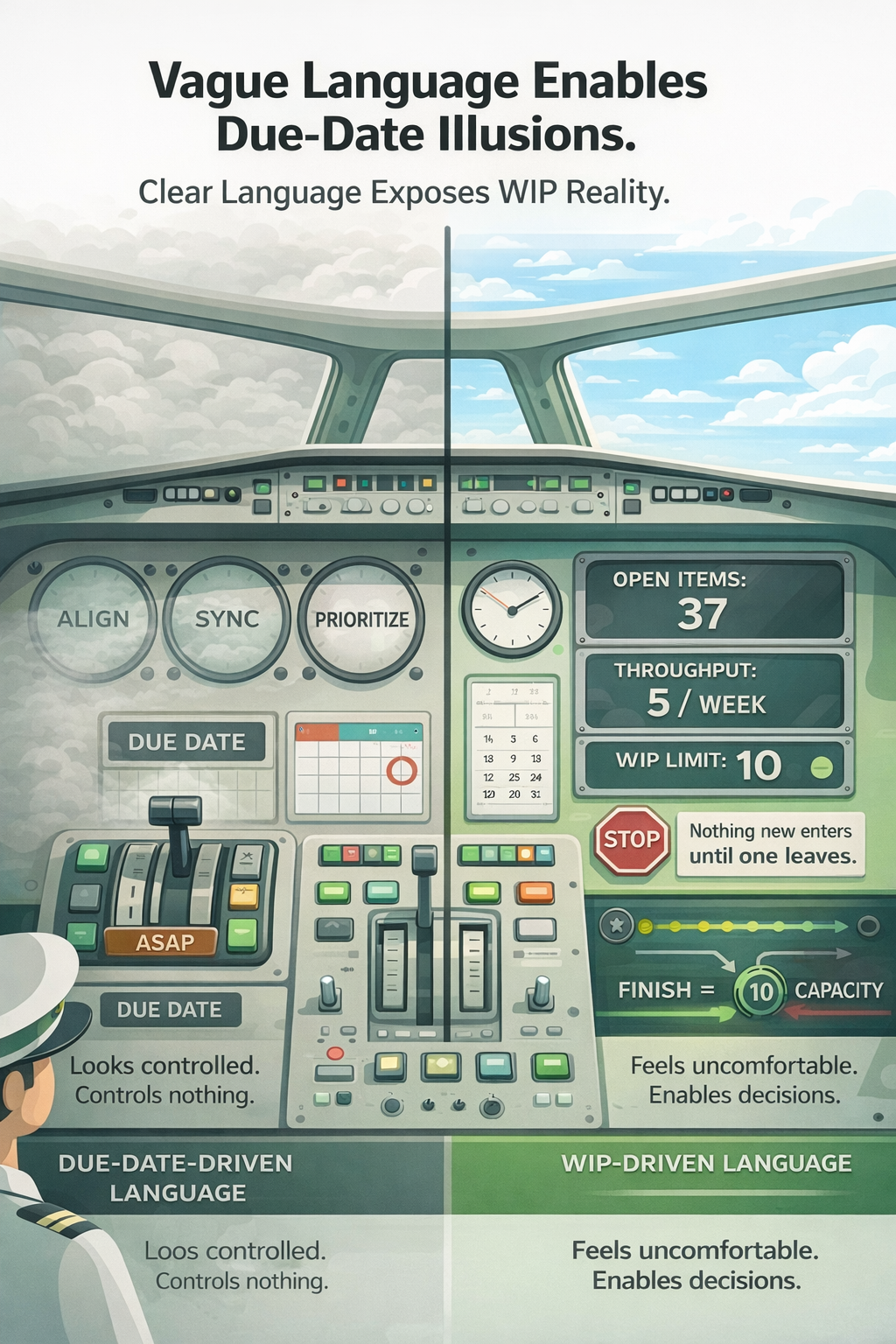
When everything runs at once, overload is inevitable. q-alizer uses work-in-progress limits to enforce flow:
- fewer parallel tasks
- shorter lead times
- lower rework rates
- more focus and depth of planning
Bottlenecks become visible before they trigger overtime. Overtime fades because the system exposes blockers early.
2. Kingsman Formula & Little’s Law:
q-alizer shows when “more hours” become counterproductive
q-alizer relies on proven mathematical models to forecast flow:
- Little’s Law quantifies the relationship between WIP and lead time.
- The Kingsman Formula shows how variability makes waiting times explode.
- Parkinson’s Law reveals artificial work expansion.
- Student Syndrome explains last-minute rush behavior.
This exposes what overtime often hides:
Structural deficits that cannot be solved with extra hours.
3. Capacity clarity instead of endless availability
Very few teams know their real capacity.
q-alizer makes it explicit:
- actual workload
- available capacity windows
- bottlenecks per hub (e.g., CAPA, Deviation, Change, Training)
- forecasted lead times
Overtime disappears because decisions are no longer made on intuition but on operational data.
4. Impact over activity:
q-alizer measures flow, not time spent
Dashboards reveal:
- completed items
- blockers
- rework rates
- decision wait times
- efficiency per hub
Suddenly it becomes clear where time creates value – and where hours are simply filled without impact.
5. Depth of planning instead of overtime phases
q-alizer strengthens:
- precise targets
- clear responsibilities
- well-defined process steps
- transparent decisions
More structure → fewer reasons for overtime. Not through moral appeals – but through a system that enforces flow.
Conclusion: The future of QC & QA will not be built with more hours, but with better structures
Overtime cultures are a global symptom – not the root cause. q-alizer reveals what they hide:
- missing prioritization
- too much parallel work
- invisible variability
- slow decision pathways
- unclear capacity boundaries
When structure is stronger than time, q_alizer becomes the strongest lever for speed, quality, and stability.

Get in contact
Intrigued and ready to learn more about how to better fly your plane?
Cool, the team is waiting to give you a demo of how easy your life will be with q_alizer™!
We’d love to talk with you!
Chief Commercial Officer (CCO)
sales@q-alizer.com
+41 76 576 2591
Paul on LinkedIn