
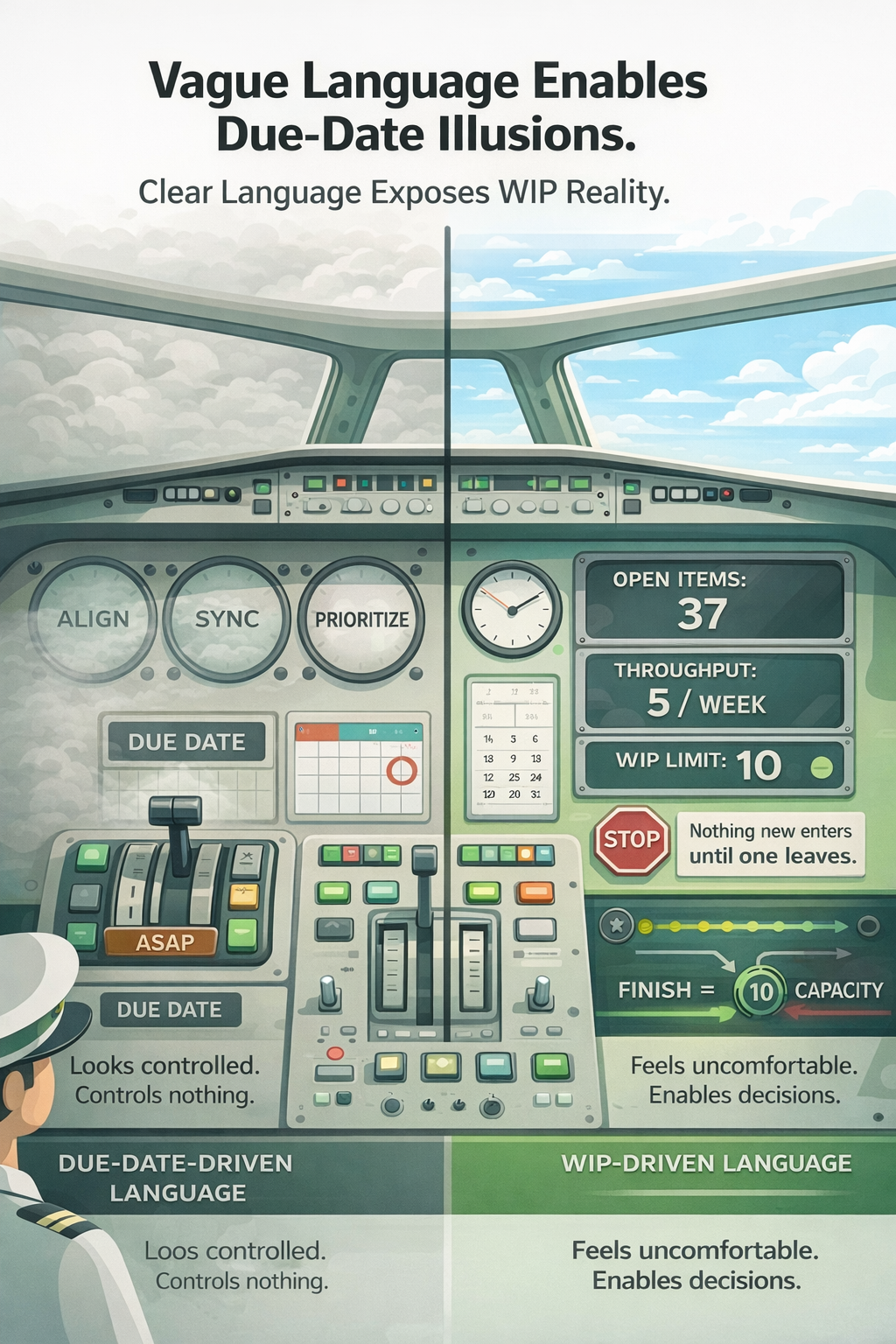
Being busy is no longer enough
Most organizations still manage work as if effort equals performance:
- Push harder when deadlines slip
- Increase utilization to meet demand
- Compensate structural issues with heroic effort
From the outside, this looks productive. From the inside, it feels fragile.
The result is predictable:
- Growing backlogs
- Unreliable delivery
- Constant firefighting
- Burnout disguised as commitment
This is not a cultural failure. It is a system failure.
The uncomfortable truth
You don’t have a productivity problem. You have a physics problem.
In complex systems, speed does not come from pressure. It comes from flow. When utilization rises and variability increases, waiting time grows exponentially. This is not opinion. It is mathematics.
The harder you push, the slower you go.
From effort to flow
Traditional management optimizes for:
- Utilization
- Deadlines
- Individual efficiency
- Heroic recovery
Flow centric systems optimize for:
- Stability under variability
- Throughput, not busyness
- Predictable lead times
- Sustainable performance
What this document gives you
q_alizer: A Flow-Centric Operating System is not a framework, a tool, or a methodology.
It is a shared language for leaders who want to understand:
- Why work waits instead of flowing
- Where performance is really lost
- How system design shapes outcomes
- Why people cannot compensate for broken systems
It makes the invisible visible:
- Backlog as a buffer, not a failure
- Flow as a system property
- Stability as a leadership responsibility
What you will learn
Inside the document:
- The flow paradox behind growing backlogs and missed commitments
- Why utilization destroys performance in variable systems
- How deadlines create overload and multitasking
- The five layers of a Flow Centric Operating System
- Why people are not buffers, and never should be
- How leaders shift from firefighting to reliable delivery
This is not about working less. It is about removing the friction that turns effort into waiting time.
Who this is for
This document is written for:
- Executives and senior leaders
- Laboratory, QC & QA leaders
- Operations, R&D, and knowledge work organizations
- Anyone responsible for system performance, not just output
If your system only works because people compensate for it, this is for you.
Download the Flow Centric Operating System. Understand why pushing harder fails, and what to do instead.
A final thought
When flow becomes visible, excuses disappear.
Transparency kills politics.
The question is not whether your people work hard enough. The question is: do you want a system that works, or one that works despite it?


